

“And It Is The People Who Should Wield It”: An Original Forum Theatre Play by Loyola Students
Directed By Kelly Howe

Production Dramaturg
Mia Luparello
Welcome!
Welcome to the dramaturgy website for Loyola University of Chicago’s Fall 2026 original Forum Theatre production! Here, you will find many resources and information about the chosen topic. Please remember this is a working document and if you have any questions or would like something added to the website, please contact me!
Contact Info:
Email: mluparello@luc.edu
The chosen topic for our Forum Theatre production is gun violence, therefore the resources provided discuss this topic and surrounding/intersecting forms of oppression including racial injustice, mental health and self harm, hate crimes, and domestic violence. There are no images included of firearms or any forms of violence on this website, but some of the outside resources included may contain such imagery. Please browse and research at your own level of comfortability!
Content Advisory:
Mental Heath Services and Hotlines
Click here to learn more about how to book an appointment for counseling with LUC’s Wellness Center.
Click here to learn more about group counseling services offered through LUC’s Wellness Center.
For life-threatening emergency care, call 911 or 44911 on campus to summon paramedics or go to the nearest hospital emergency room.
The Wellness Center has a service available for students who are in a non life-threatening crisis and need immediate assistance to speak to counselors and to receive crisis consultation, information on emergency resources, or even be directed to the Emergency Department, if appropriate. This service is available by calling 773-508-2530, Option 3 after hours, which includes weekends and holidays.
Trilogy Behavioral Health offers a first-response Alternative Crisis Team (FACT) provides urgent mobile response and interventions, as well as follow-up support, for individuals who are experiencing a mental health crisis. FACT operates in Rogers Park, Edgewater, West Ridge, Uptown, Skokie, and Evanston. Call 800-FACT-400 if you or someone is experiencing a mental health crisis to have someone respond in real-time.
Call 988 for the National Suicide Prevention Lifeline. You may also text the Crisis Text Line at 741741 to communicate with a trained crisis counselor.
Table of Contents
Theatre of the Oppressed
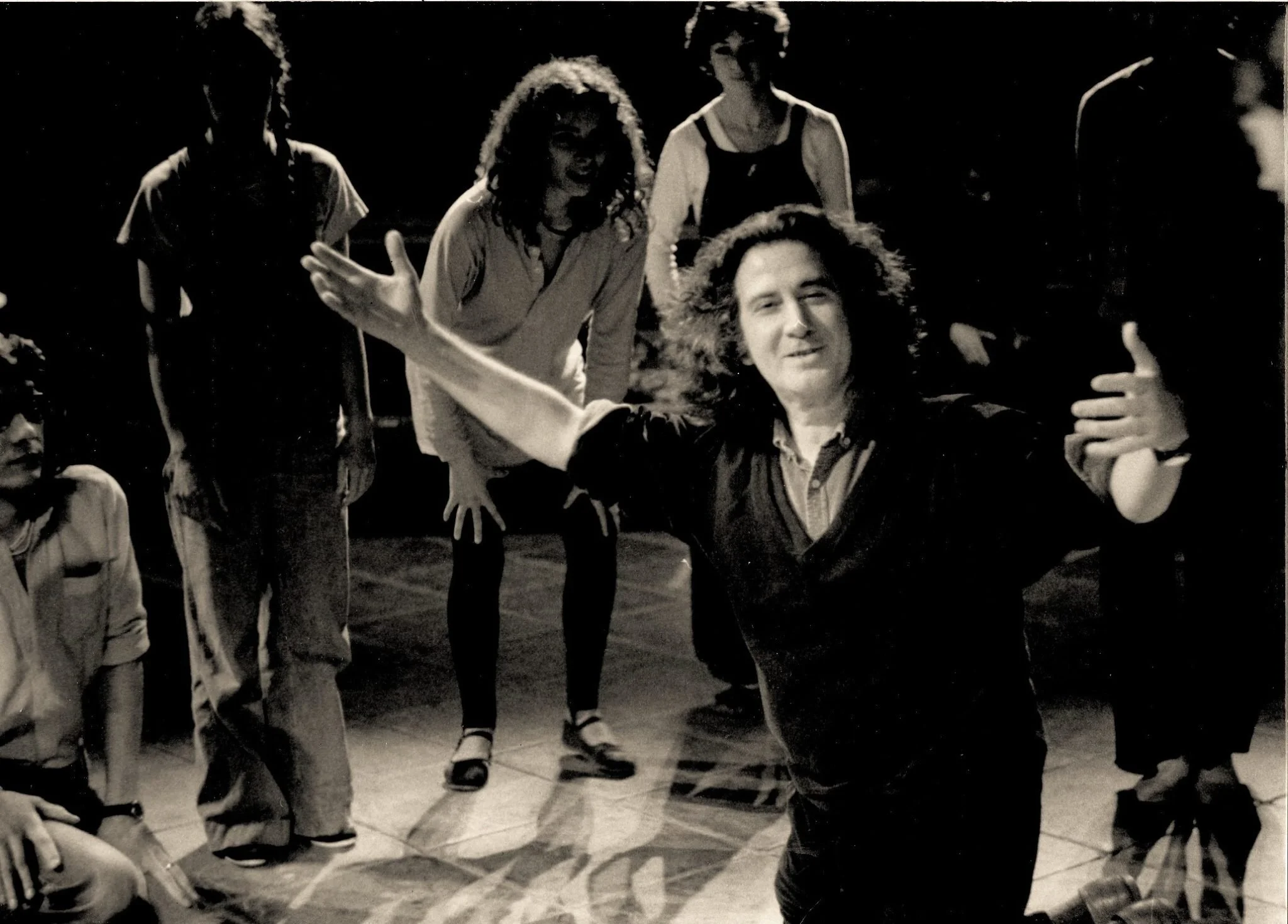
“The theatre is a weapon, and it is the people who should wield it.”
-Augusto Boal

Watch until 11:48
Forms and Techniques of TO
-
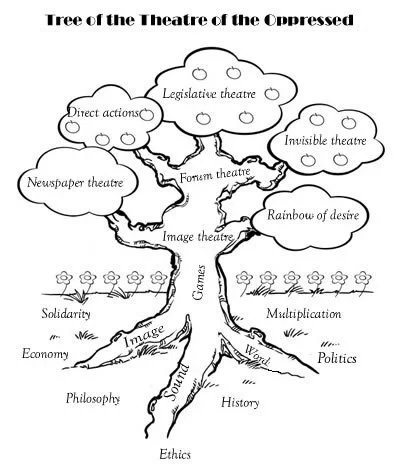
Participants sculpt their bodies to make non-verbal tableaus or images that explore a concept or delve into how a group thinks about a certain concept.
-
Description text goes here
-
Participants publicly enact a scenario as if it were a real event. The scenario deals with a specific form of oppression and gets played within the context that it regularly occurs. These performances are meant to provoke reactions and debate amongst spectators.
-
A type of Forum theatre that takes place in town halls and houses of legislature where a given law policy or statue is being debated
Forum Theatre
Participants create a scene or play that demonstrates a form of oppression. The scene features a protagonist who is trying to complete an objective surrounding that specific form of oppression. The protagonist is left unsatisfied at the end of the play as they are unable to complete their objective. The scene or play is then performed a second time, but now an audience member, or spect-actor, can replace a character to then improvise and find ways to combat the systems of oppression that are being represented. This process is facilitated by the Joker, who can then ask questions about the spec-actor’s strategy to then create a kind of town-hall, or forum, in the audience.
Gun Violence Prevention: Activism and Resources
Everytown for Gun Safety
Everytown For Gun Safety is the largest gun violence prevention organization in the US. Everytown promotes evidence-based solutions throughout everytown in the US to educate people and fight towards reducing gun violence. Everytown hosts several movements including Moms Demand Action, Student Demand Action, and Gun Sense Action Network.
Brady: United Against Gun Violence
Brady is the oldest and one of the largest organizations against gun violence in the US. Founded in 1974, Brady’s strategy targets policy reform, industry oversight, and cultural change.
Giffords
Giffords is an organization led by former Arizona Congresswoman Gabrielle Gifford. The organization’s strategy is fighting the gun lobby campaigns and litigation in courts.
Community Justice Action Fund
Community Justice Action Fund is a gun violent prevention organization that focuses on ending gun violence in Black and Brown communities. Their mission is to empower those whose experiences are closest to the issue to build political power, amplify voices, and advocate for policy change.

Sandy Hook Promise
Sandy Hook Promise is an organization founded and led by some family members who had lost loved ones in the 2012 Sandy Hook Elementary School shooting. Their goal is to educate young students and educators on the warning signs of potential violence to seek help.

Chicago CRED
Chicago CRED is a non-profit gun violence prevention organization that uses a street outreach and intervention approach to support those who are at the highest risk for gun violence involvement in Chicago communities.
Resource Links
Personal Narratives: Obstacles in Activism
Retraumatization and Secondary Trauma
“We had PTSD, not just from the shooting, but also from the organizing. I had to learn how to feel again, how to be human, because I was working 24/7,” he said. “The most selfish thing you can do when you have an important task to do is to refuse to take care of yourself. “
—March for Our Lives Cofounder David Hogg for Cal Poly, 2022
Power and Influence of the Opposition
“This powerful industry, whose products often place the population’s health at risk, faces a less powerful and fragmented resistance movement composed of groups of social activists with limited funds and varying levels of public support…These organizations continually work for greater firearm safety with their limited funds and relatively small staffs. Unfortunately, only in the wake of mass murders do these organizations garner wide public attention.”
—Charles D. Phillips for NIH, 2018
Politcal Violence
***A major concern in activism is law enforcement’s access to weapons of war. The quote provide below comes from a gun violence prevention activist discussing this concern in the context of the Black Lives Matter movement, but these concerns surrounding weapons of war still relates to many other communities, activists, and movements****
“Giving law enforcement weapons of war creates an endless cycle of violence that disproportionately affects Black people. We are a society that has chosen to let law enforcement kill Black people in near-total impunity and attack protesters who peacefully exercised their right to speak up against these human rights abuses. This research shows that the police will stop at nothing to squash protesters. No one had to lose their eyesight, get sick, or forever fear the police because they wanted to say that Black lives matter. It’s time to end these human rights violations once and for all.”
—Ernest Coverson (End Gun Violence Campaign Manager for Amnesty International USA)
Lack of Resources
“We need to address the fact that the communities most impacted by gun violence are the black and brown communities with the least resources. We need to address the economic collapse of rural America, because two-thirds of gun deaths are suicides that predominantly happen in suburban and rural America with people who have easy access to guns. We can't treat those things as mutually exclusive. We have to raise both because both are the results of a lack of resources.
—March for Our Lives Cofounder David Hogg for Cal Poly, 2022
Inaction of Legislators
Statistics, Studies, and Data Trackers
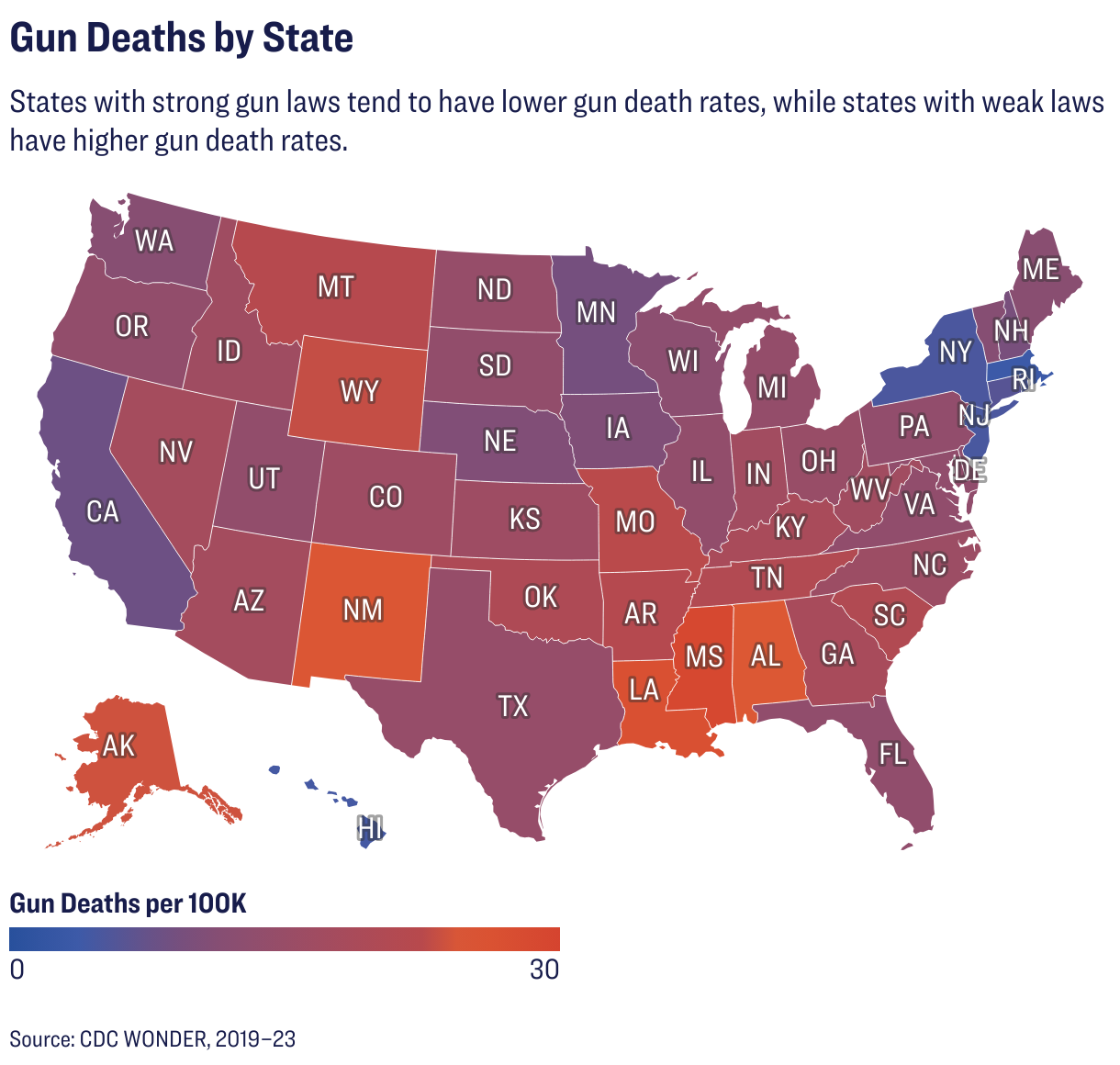
About 46,000 US Americans die from gun violence every year—an average of more than 125 per day
As of 2022, the United States has 121 Firearms per 100 residents. Making it the only country with more civilian-owned firearms than people.
Gun violence costs the United States approximately $557.2 billion each year, of which $12.6 billion (2%) is paid by taxpayers.
The rate of gun deaths has increased 15% from 2015 to 2024
By the end of 2026, an estimated 1.27 million guns will have been illegally trafficked since 2017.
Gun Deaths in 2024
Issues and Intersecting Forms of Oppression
Gun Suicide:
Everytown Research: Firearms Suicide in the United States
Racial Injustice:
Article 2
Hate Crimes:
Giffords: Hate Crimes
Everytown Research: Disarm Hate: The Deadly Intersection of Guns and Hate Motivated Violence
Police Violence:
Brady: Preventing Police Violence
Everytown: Gun Violence by Police
Domestic Violence:
Johns Hopkins University: Domestic Violence and Firearms
LGBTQIA+:
Sandy Hook Promise: Facts and Statistics About the Impact of Gun Violence on LGBTQ+ People
Access, Supreme Court Cases and Laws
Check State by State Gun Laws
Learn More About Background Checks
Federal Gun Laws
-
“A well regulated Militia, being necessary to the security of a free State, the right of the people to keep and bear Arms, shall not be infringed.”
-
The National Firearms Act is a federal law that was passed in 1934. The law charges an excise tax on the manufacturing and transferring of specific firearms. These specific firearms include machine guns, short barreled rifles, short barreled shotguns, firearm suppressors/silencers, explosives, and concealable handguns. The law also requires that all NFA firearms are registered through the National Firearms Registration and Transfer Record and also requires that all NFA firearms that are carried across state borders must be reported to the Bureau of Alcohol, Tobacco, Firearms and Explosives (ATF).
The NFA was amended in Title II of the Gun Control Act of 1968 (GCA) after the decision of Haynes v. United States (1968). The GCA changed the NFA so that those who already possessed unregistered firearms were not required to register them. The NFA was also amended in the Firearm Owner’s Protection Act to specify the definition of silencers.
-
The Omnibus Crime Control and Safe Streets Act is a law that assists state and local governments in reducing crime and improving law enforcement training. The law enacted federal restrictions on interstate and mail-order handgun sales. These firearm provisions were expanded in the Gun Control Act of 1968.
-
The Gun Control Act is a federal law that imposes regulations on foreign and interstate commerce of firearms. The law This law was proposed in response to the assassination of President John F. Kennedy in 1963. The Gun Control Act regulates interstate commerce of firearms by limiting who can participate in interstate trade or transfers to licensed dealers, manufacturers, and importers. Additionally, the Gun Control Act also established a minimum age requirement for purchasing a firearm and banned “prohibited persons” from purchasing or possessing ammunition and firearms.
-
The Firearm Owners Protection Act relaxed many of the gun control policies established in the Gun Control Act of 1986 by giving the ATF more flexibility in the enforcement of regulations regarding licensing dealers and inspections, thus redefining what “gun dealer” means in federal legislation. The law emerged out of abuse allegations made by the NRA against ATF inspectors, specifically that the ATF inspectors were abusing their power in their record keeping of firearm dealers. The law also federally protected the ability for citizens to travel with an unloaded, securely stored firearm.
-
Undetectable Firearms Act is a federal law that was passed in 1988. The act prohibits the carrying of any firearm that cannot be detected by screenings such as metal detectors or x-ray machines.
-
The Brady Handgun Violence Prevention Act requires that all federally licensed firearm dealers run background checks on those wanting to purchase a handgun. The law required a 5 day waiting period for handgun purchases so that dealers could complete background checks. The waiting period was later replaced by the National Instant Criminal Background Check System (NICS). To learn more about how the background check process works, check out the resource provided on the left of this section!
-
Item description
-
Item description
-
Description text goes here
-
Description text goes here
-
The Bipartisan Safer Communities Act includes extended background checks for firearm purchases under the age of 21, clarification of the federal firearms license (FFL) requirements, funding for state red flag laws and other crisis intervention programs, further criminalization of arms trafficking and straw purchases, and partial closure of the gun show loophole and boyfriend loophole. In 2024, the ATF and DOJ finalized the definition of individuals engaged in business of dealing firearms, clarifying that unlicensed sellers as must register FFLs and run background checks.
Supreme Court Cases
District of Columbia v. Heller (2008): The Second Amendment protects an individual right to possess a firearm unconnected with service in a militia, and to use that arm for traditionally lawful purposes, such as self-defense within the home.
McDonald v. City of Chicago (2010): The Fourteenth Amendment incorporates the Second Amendment right to keep and bear arms for the purpose of self-defense. (In other words, the right is protected from state as well as federal interference.)
Caetano v. Massachusetts (2016): The Second Amendment extends to all instruments that constitute bearable arms, even those that were not in existence at the time of the founding, and this Second Amendment right is fully applicable to the states.
New York State Rifle & Pistol Association, Inc. v. Bruen (2022): When the Second Amendment's plain text covers an individual's conduct, the Constitution presumptively protects that conduct. To justify a firearm regulation, the government must demonstrate that the regulation is consistent with the nation's historical tradition of firearm regulation.
United States v. Rahimi (2024): An individual found by a court to pose a credible threat to the physical safety of another person may be temporarily disarmed consistent with the Second Amendment.
Bondi v. Vanderstok (2025): The Gun Control Act of 1968 permits the Bureau of Alcohol, Tobacco, Firearms and Explosives to regulate some weapon parts kits and unfinished frames or receivers.
The Opposition
The National Rifles Association (NRA) and the Gun Lobby
The NRA is a prominent gun rights advocacy organization in the United States. The NRA was founded in 1871 as a recreational organization with the intent to "promote and encourage rifle shooting," but has since evolved into one of the most influential political advocacy organizations in the country. The organization lobbies against gun control laws, mainly through defending their contended interpretation of the Second Amendment of the US Constitution. The NRA’s lobbying division, the NRA Institute for Legislative Action (NRA-ILA), has historically and actively continues to be successful in influencing American gun policy and the voting behavior of their followers. To learn more about the NRA and their initiatives click here to visit their website.
Glossary
-
The Gun Show Loophole is a term that refers to selling or trading of a firearm in absence of the federal requirement for background checks for private sales of firearms. Sales and trading of firearms includes trades at gun shows, flea markets, or online.
-
The Boyfriend Loophole is a term given to the gap in older gun laws that allowed for physically abusive ex-partners and stalkers with previous convictions and/or restraining orders to obtain firearms. The loophole was introduced when the Lautenberg Amendment, which banned people with domestic violence convictions from owning guns, was introduced. The Lautenberg Amendment ban only applied if the abuser was married to, had a child with, or lived with the victim. Therefore if the abuser did not live with or was never married/had children with their victim, they could obtain a firearm.
-
Bump stocks are attachments that can simulate rapid/automatic fire by using the recoil on semi-automatic firearms.
-
Ghost guns are homemade firearms built with parts often acquired from kits, 3D printers, and/or unfinished firearms. Ghost guns can be constructed by anyone, meaning that those who are prohibited from purchasing a gun are able to acquire a firearm and evade federal restrictions. Additionally, because they are not serialized nor regulated as heavily as firearms, ghost guns undermine gun laws making them an emerging weapon of choice in criminal activity. Several state governments have placed bans and regulations on ghost guns. In 2022, the ATF finalized a rule to federally regulate ghost guns, defining them as firearms so that they are subjected to Brady Background Checks. This rule has been challenged and court and is continuing to be challenged.
-
Description text goes here
-
Also known as concealed carry reciprocity (CCR), this mandate would force every US State to recognize the concealed carry standards of every other state. This means that states with much stricter standards would have to recognize those of states that have drastically weaker standards, or even no standards at all. CCR is a major threat to public safety and is currently being proposed through bills such as the Constitutional Concealed Carry Reciprocity Act.